
- Carpet
How to Choose Carpet for Houston Stairs: The One Warranty Question Nobody Asks
September 15, 2026
Reviewed for accuracy by the Roberts Carpet & Fine Floors team, Houston’s only National Floorcovering Alliance (NFA) member dealer.
In any carpeted Houston home, the stairs are the first place the carpet will show its age. That is not a flaw in the design — it is physics. Every step concentrates the full weight of every person who uses the house into a narrow strip of fiber at the nose of each tread, then releases it with the next step. Thousands of times a year. On a surface that gets no rest and very little maintenance attention.
Choosing carpet for stairs is not the same decision as choosing carpet for a bedroom or even a hallway. The fiber requirements, pad specifications, and installation standards are all more demanding. And there is one question before you buy that reveals more about carpet quality than any spec sheet on the market.
Roberts Carpet & Fine Floors has installed stair carpet across Houston’s two-story homes for 42 years — from Cinco Ranch to the Heights to Friendswood. Visit any of our nine showrooms to see how we match fiber and construction to the specific demands of your stairs.
Key Takeaways
- Ask whether the carpet warranty covers stairs before you buy. If the manufacturer backs it on stairs, trust the product — regardless of face weight or twist numbers.
- For stairs, choose a dense, low-pile carpet from nylon or SmartStrand (triexta) — both resist crushing and maintain appearance under concentrated foot traffic.
- Avoid plush or soft carpets on stairs — they show tracking patterns quickly and compress unevenly at the nosing, which is where stair carpet fails first.
- Use a firm, thin pad on stairs — 3/8 to 7/16 inch thick with at least 8-pound density. Soft or thick foam pads compress under repeated stair traffic and accelerate wear.
- Proper power-stretching during stair installation is essential. Loose or inconsistent tension from tread to tread is the most common sign of poor installation — and a warranty risk.
Why Are Stairs the Hardest Test for Any Carpet?
Stairs are not just a high-traffic area. They are the highest-concentration wear surface in any home. On a flat floor, foot traffic is distributed across a wide area. On a staircase, every step loads the same small zone at the nose of each tread, day after day.
“Stairs are the one place in your home where carpet choice really gets tested,” says the Roberts Carpet team. “Every single step concentrates wear into a small band of fiber at the nose of each tread. If the carpet and pad can hold up there, they can hold up anywhere.”
In Houston’s two-story suburban homes — across Katy, The Woodlands, Sugar Land, and Pearland — staircases see constant use from family members, pets, and frequent guests. The foot traffic volume is high, the wear is focused, and the consequences of a poor product or poor installation are visible faster than on any other surface in the house.
The One Question That Reveals Carpet Quality Before You Buy
Before committing to any carpet — even if you have no stairs to carpet — ask this question: Does the warranty cover stairs?
The answer tells you more about the product than face weight, twist number, or any other spec. Stairs are the toughest environment a residential carpet faces. When a manufacturer is willing to warrant their carpet on stairs, they are making a direct statement about confidence in the fiber and construction. When stairs are excluded from the warranty, that is a signal.
“Before we recommend any carpet, we ask if the client plans to put it on stairs — even if they are not,” says the Roberts Carpet team. “It is not a logistics question, it is a quality question. If the manufacturer will not warrant it on stairs, that tells you something about how much they believe in the product.”
You do not need to use this information to make a stairs-specific decision. A carpet that passes the stairs test is simply a better-built carpet. That confidence translates to better performance everywhere in the home — in hallways, living rooms, and any space that sees daily use.
Which Carpet Fiber Is Right for Houston Stairs?
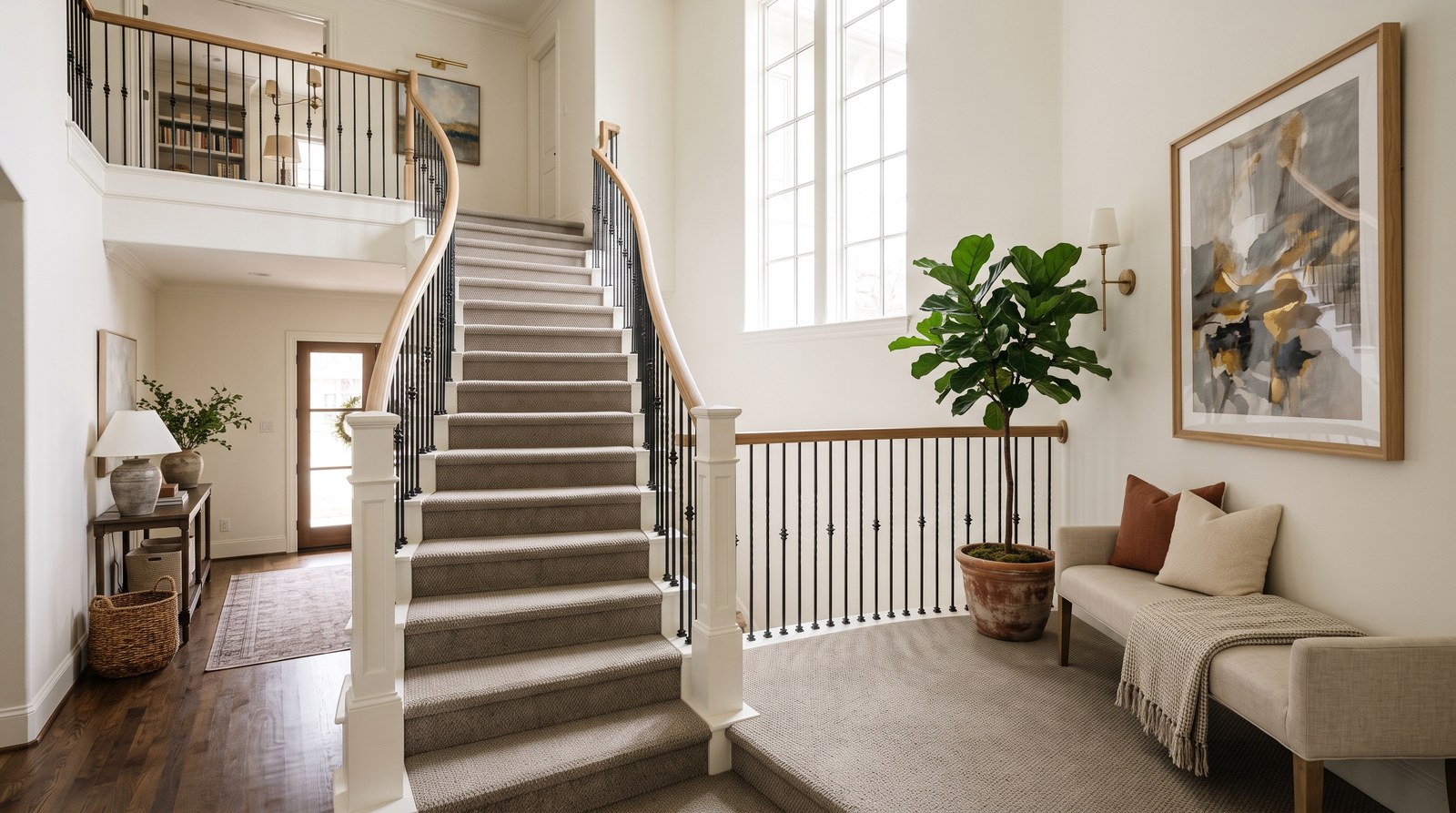
For stairs, the fiber choice narrows considerably. Dense, low-pile carpets made from nylon or SmartStrand (triexta) are the strongest choices. Both fibers resist crushing and wear under concentrated foot traffic, and both maintain their appearance without matting down under heavy use.
The carpet style matters as much as the fiber. A dense, low-pile or cut-loop construction distributes foot pressure more evenly than a plush or shag style, which concentrates compression at the contact points. Plush or soft carpets tend to show tracking patterns quickly on stairs and compress unevenly at the nosing — which is exactly where stair carpet fails first and becomes a safety concern.
For homes with pets or children, solution-dyed nylon or SmartStrand are the most practical choices for stairs. Solution-dyed fibers have color and stain protection built permanently into the fiber — they do not rely on topical treatments that wear away from the concentrated foot traffic at each tread nose.
“From sale through coordination and installation, this was the finest carpeting experience in 40+ years (6 homes). Courteous. Professional. Timely. Great communication. What more needs to be said?”
Houston Customer — Premium Carpet Installation
What Pad Should You Use on Carpet Stairs?
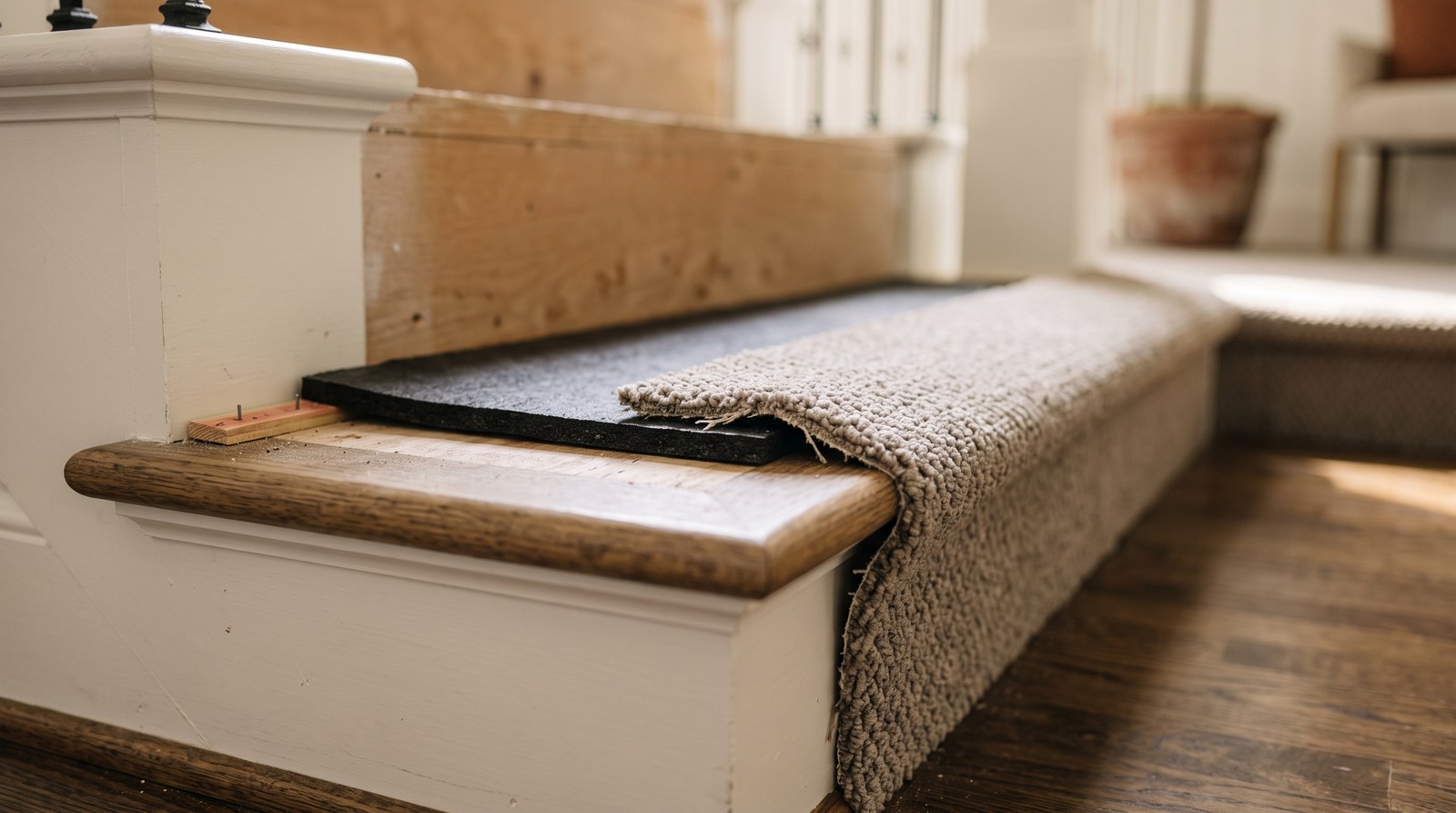
The pad specification for stairs is different — and more demanding — than for flat floor applications. For high-traffic areas like hallways and stairs, use a slightly thinner pad, around 3/8 to 7/16 inch thick with a higher density of 8 pounds or more. This keeps the carpet stable and prevents premature wear.
The instinct to use a thick, soft pad on stairs because it feels more cushioned is a mistake. A soft pad compresses under the repeated impact of each step and provides inconsistent support at the nosing — which is the point of highest stress. Over time, this accelerates the very wear pattern you are trying to prevent.
Rubber padding is particularly well-suited to stairs. Its density and durability under concentrated load make it one of the most reliable pad choices for this application. Regardless of pad type, the specification for stairs should always favor firmness and density over thickness and softness.
Pro-Tip from the Roberts Carpet Team: In Houston’s larger family homes — particularly two-story plans in Katy, Cypress, and The Woodlands — the staircase connects the most-used floors in the house. We always recommend treating the stairs as a separate specification from the rest of the carpet installation. The fiber, construction, and pad that make sense for a bedroom or living room are often not the right spec for the stairs. Ask your Roberts consultant to give you a stairs-specific recommendation before the installation is scheduled.
How Does Installation Quality Affect Stair Carpet Performance?
Installation on stairs is more technically demanding than on flat floors. The carpet must be anchored precisely at each tread and riser, the tension must be consistent from step to step, and the nosing — the front edge of each tread — must be cleanly wrapped and secured without gaps or bunching.
The most common installation failure on stairs is improper stretching. Carpet that is not power-stretched correctly develops loose edges and sagging at the tread nose over time. On stairs, this is not just an aesthetic problem — loose carpet at the nosing is a slip-and-fall hazard and a warranty concern.
Signs of poor stair installation include: loose or sagging carpet edges on individual treads, wrinkles that develop along the nosing, inconsistent tension from step to step, and carpet that moves or shifts when walked on. These issues may be subtle at first but worsen with use and are typically not covered under the carpet manufacturer’s warranty because they result from installation error, not product failure.
Why Working With a Houston Flooring Expert Matters for Stair Carpet
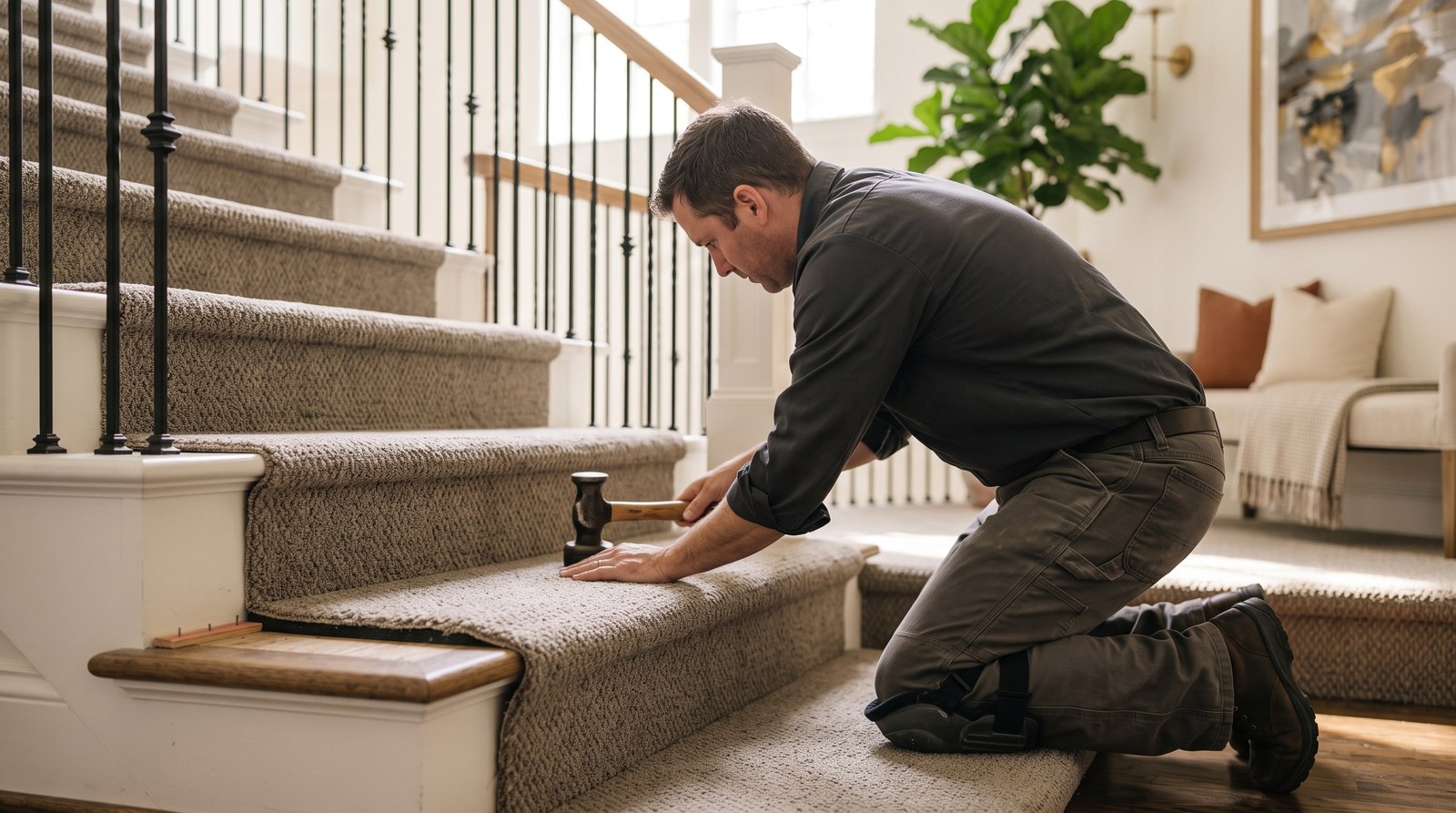
Stair carpet installation requires more skill and attention than flat-floor installation. The Roberts Carpet installation team has experience with every stair configuration common to Houston’s housing stock — from the straight open-riser staircases in Katy new-builds to the curved, closed-riser staircases in older Heights and Bellaire homes.
Roberts Carpet & Fine Floors is Houston’s only member of the National Floorcovering Alliance (NFA), an elite group of fewer than one-tenth of one percent of all U.S. flooring dealers. NFA membership means access to top-tier manufacturer products, direct warranty support, and installation crews who are trained to meet manufacturer specifications — not just general standards.
If you are replacing stair carpet or selecting carpet that will run from a lower floor up through the staircase, visit our carpet page or request a complimentary estimate and our team will measure the full run and provide specs tailored to your stairs.
Ready to Choose the Right Carpet for Your Houston Stairs?
Walk in at any of our nine showrooms — no appointment needed. Our team will ask the stairs question before recommending anything, and we will make sure the fiber, style, pad, and installation plan match the demands of your specific staircase. Book your complimentary estimate online and we will have a turnkey quote ready within 48 hours. Call our Houston Central showroom at (713) 523-0666 any day.
This article is based on an expert interview with a Roberts Carpet & Fine Floors flooring specialist and reviewed for accuracy by the Roberts Carpet & Fine Floors team, Houston’s only National Floorcovering Alliance (NFA) member dealer. Last updated September 14, 2026.
Frequently Asked Questions
What is the best carpet for stairs in Houston?
For Houston stairs, choose a dense, low-pile carpet from a durable fiber — nylon or SmartStrand (triexta) are the top choices because of their wear resistance and ability to maintain appearance under concentrated foot traffic. Avoid plush or soft carpets on stairs; they show tracking patterns quickly and compress unevenly. Pair with a firm, high-density pad of 3/8 to 7/16 inch thick with at least 8-pound density.
Does the carpet warranty cover stairs?
Not all carpet warranties cover stairs — and whether a warranty covers stairs is one of the most useful quality signals before you buy. Stairs experience the highest wear of any surface in a home. When a manufacturer is willing to warrant a carpet on stairs, it signals confidence in the fiber and construction. If stairs are excluded from the warranty, that tells you something meaningful about the product.
What are signs of poor carpet installation on stairs?
Signs of poor stair carpet installation include loose or sagging carpet edges on treads, inconsistent tension from step to step, wrinkles along the nosing, and carpet that feels uneven or moves when walked on. Poor stair installation usually results from failing to power-stretch correctly and not anchoring each tread properly. These issues worsen over time and can affect warranty coverage.
What carpet pad should I use on stairs?
For stairs, use a firm pad — rubber padding or a high-density rebond pad — that is 3/8 to 7/16 inch thick with a density of 8 pounds or more. Soft or thick foam pads compress quickly under repeated stair traffic and accelerate carpet wear on the nosings and risers. The pad on stairs should be thin and firm, not thick and soft.
Should I match stair carpet to my landing or main floor carpet?
For visual continuity, stair carpet often continues from the main floor carpet or the upstairs hallway, which is a common choice in Houston two-story homes. You can also use a complementary pattern or texture that coordinates rather than matches exactly. The fiber and construction of the stair carpet should meet stair-specific durability standards regardless of whether it matches the adjacent floor.