
- Flooring
Subfloor Preparation: The Hidden Step That Makes or Breaks Your Houston Floor
July 30, 2026
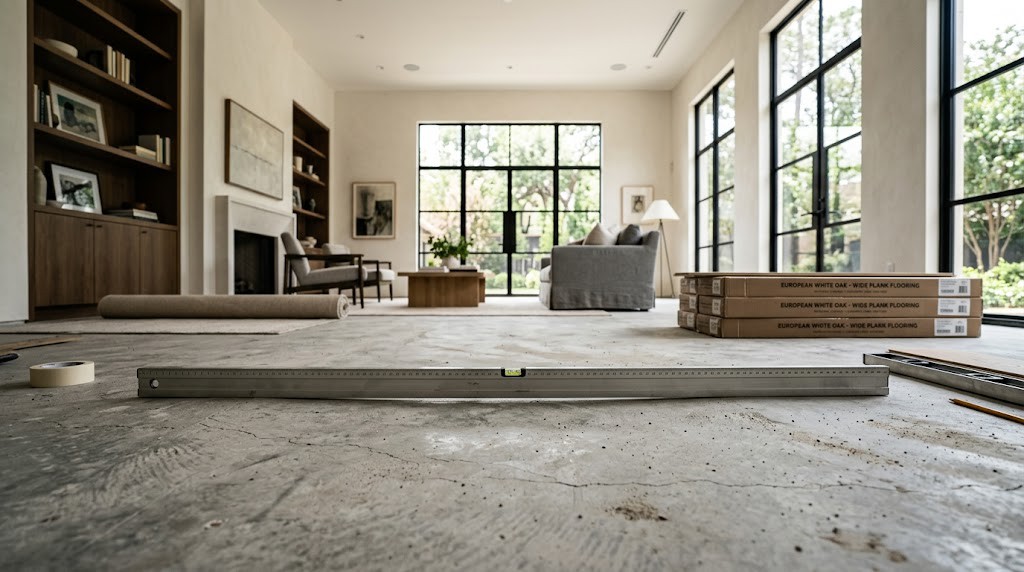
Most Houston homeowners spend weeks choosing the perfect flooring. They compare colors, textures, and price points across every showroom in town. Then they hand the project off to an installer and assume the hard part is over. It is not. The subfloor underneath your new floor determines whether it performs for decades or fails in months, and most homeowners never see, touch, or think about it.
In Houston, subfloor conditions are more complicated than almost anywhere else in Texas. The city’s expansive clay soils create slab movement that quietly changes subfloor flatness over time. If nobody checks for these changes before installation, the new floor pays the price.
Key Takeaways
- The subfloor must be sound, solid, and flat before any hard surface flooring product is installed. Skipping this step is the most common cause of premature flooring failure.
- Professional installers aim for a “flat” subfloor, not a “level” one. Flat means no high or low spots. Level means plumb with gravity, which is nearly impossible in Houston homes due to soil movement.
- Houston’s Lake Charles and Beaumont clay soils cause seasonal slab movement that creates subfloor irregularities invisible to the eye but measurable with a straightedge.
- Most flooring manufacturers require documented subfloor moisture testing before installation. Skipping it voids your warranty.
- A professional subfloor assessment takes less than an hour and can prevent thousands of dollars in post-installation failures.
Why Is the Subfloor More Important Than the Flooring on Top?
Your subfloor is the foundation of every flooring product in your home. If it is not flat, dry, and structurally sound, the flooring on top will eventually gap, cup, buckle, or delaminate. No product, regardless of its quality or price, can overcome a bad subfloor.
Installing hard surface flooring is a construction-type project. The installer must evaluate the entire subfloor before the first plank, tile, or carpet pad goes down. This evaluation includes flatness, moisture content, structural integrity, and compatibility with the chosen flooring product.
“Nine times out of ten, when we get called to look at a failed floor, the product is fine,” says the Roberts Carpet & Fine Floors team. “It is the subfloor underneath
that was never properly prepared. That one skipped step cost the homeowner the entire project.”
What Does “Flat” Mean, and Why Isn’t “Level” the Goal?
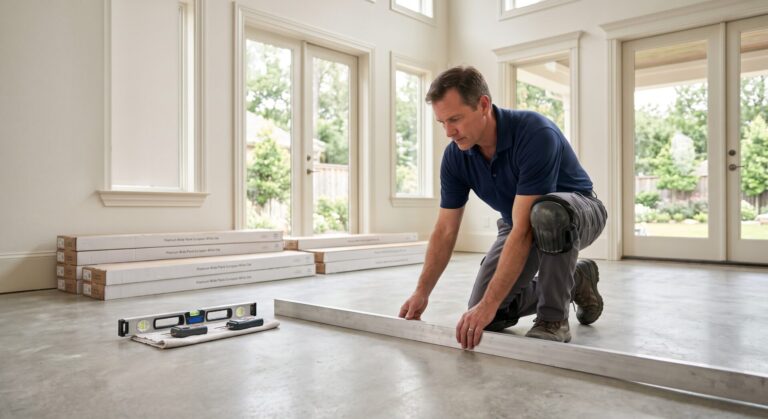
A flat subfloor has no high or low spots that would cause flooring to rock, gap, or telegraph imperfections. The National Wood Flooring Association (NWFA) publishes a standard tolerance of 3/16 of an inch within a 10-foot span for most hard surface installations. Anything outside that range requires correction before the flooring goes down.
Level means the surface is perfectly plumb with gravity. Professional installers do not aim for level because achieving it is nearly impossible in residential construction. Houston homes shift over time. Soil settles. Slabs flex. A floor that was level the day the concrete was poured may have measurable variation years later.
The practical difference matters. A flat floor gives your flooring a stable, consistent surface to rest on. A floor that is not perfectly level but is flat will still perform beautifully. A floor that is level but has high and low spots will cause problems from day one.
How Do Houston’s Soils Create Subfloor Problems?
Houston sits on expansive clay soils, primarily the Lake Charles and Beaumont clay series. These soils absorb moisture during wet seasons and shrink during dry spells. The cycle creates subtle but measurable slab movement that affects subfloor flatness over months and years.
In established neighborhoods like Meyerland, where slab-on-grade construction from the 1950s through 1970s is common, decades of soil movement can create subfloor variations that are invisible to the eye but obvious to a 10-foot straightedge. In newer subdivisions in The Woodlands and Cinco Ranch, freshly poured slabs on graded clay have not fully settled, and movement in the first five to ten years can be more pronounced.
Houston’s 75% average annual humidity adds another layer of complexity. Moisture migrates through concrete slabs continuously. Without proper testing and, in some cases, a moisture barrier, that moisture can compromise adhesives, cause wood to cup, and push LVP expansion gaps beyond tolerance.
Pro-Tip from the Roberts Carpet & Fine Floors Team: In Houston, we never rely on a single moisture reading. We test multiple points across the slab because moisture levels can vary dramatically from one side of a room to the other, especially in homes near bayous or in low-lying areas of Fort Bend and Brazoria counties.

What Does a Professional Subfloor Assessment Include?
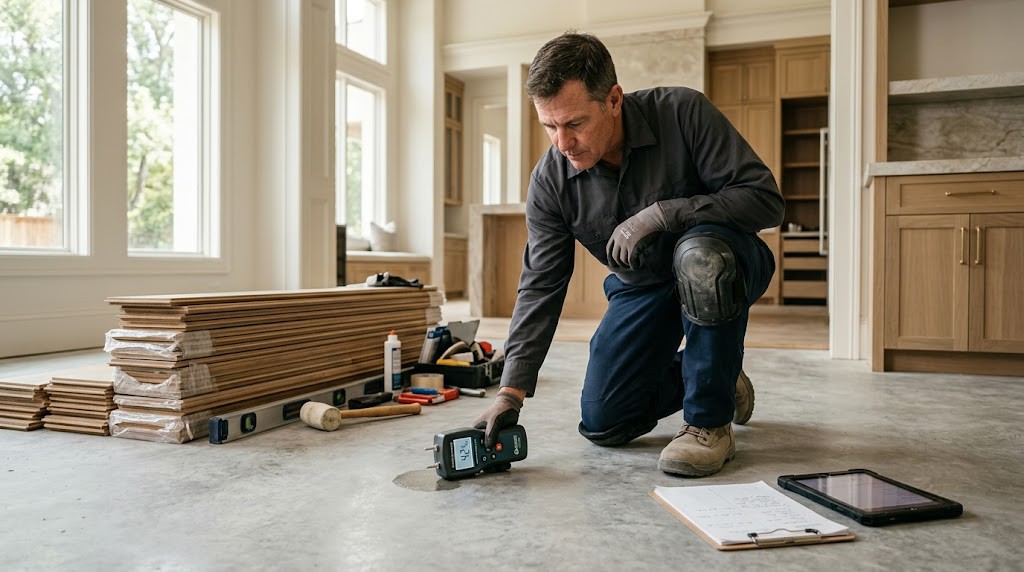
A professional assessment covers four areas. First, the installer checks flatness using a straightedge across multiple directions in every room. Second, they test subfloor
moisture with a calibrated meter and document the results. Third, they evaluate structural deflection by checking for flex or bounce in the subfloor when walked on. Fourth, they inspect for cracks, voids, old adhesive residue, or previous repair patches that could affect the new installation.
This assessment takes less than an hour on most jobs. The corrections it identifies, whether leveling compound, moisture barrier, or crack repair, prevent failures that would cost far more to fix after installation.
“We do not install on hope,” says the Roberts Carpet team. “We test, we document, and we correct any issue before the first plank goes down. That is what protects your floors and your warranty.”
How Does Subfloor Prep Protect Your Warranty?
Most flooring manufacturers require documented proof that the subfloor met their specifications before installation. If your floor fails and you file a warranty claim, the first thing the manufacturer asks for is the pre-installation moisture test results and the installer’s site assessment documentation.
If those records do not exist, the claim is denied. If the subfloor was not flat, the claim is denied. If a moisture barrier was needed but not installed, the claim is denied. Subfloor preparation is not just a best practice. It is a warranty requirement.
If a floor floods, water penetrates the joints and causes the subfloor to swell. That failure is never covered by a warranty. But the difference between a floor that survives a minor leak and one that catastrophically fails often comes down to whether the subfloor was properly sealed and prepared in the first place.
Why Should You Trust a Professional Dealer for Subfloor Work?
Roberts Carpet & Fine Floors, Houston’s only National Floorcovering Alliance (NFA) member, has coordinated professional flooring installations across Greater Houston since 1984. Their installation teams perform full subfloor assessments on every job, document results, and correct issues before installation begins.
NFA dealers represent fewer than one-tenth of one percent of all flooring retailers in North America. They are selected for their commitment to doing the job right, which starts with the subfloor. Proper preparation is invisible after the floor is installed, but it is the single most important factor in whether that floor lasts.
Visit any of our ten Houston-area showrooms or call (713) 523-0666 for a complimentary measure and turnkey quote within 48 hours.
Frequently Asked Questions
Why is subfloor preparation important before flooring installation?
The subfloor is the foundation for every flooring product. If it is not flat, dry, and structurally sound, the flooring on top will gap, cup, buckle, or delaminate. Skipping subfloor prep is the most common cause of premature flooring failure and voided warranties.
What is the difference between a flat subfloor and a level subfloor?
Flat means the surface has no high or low spots within a given span. Level means the surface is perfectly plumb with gravity. Professional installers focus on flatness because achieving true level is nearly impossible in Houston homes due to soil movement and settling over time.
How does Houston’s clay soil affect subfloor conditions?
Houston sits on expansive Lake Charles and Beaumont clay soils that swell when wet and shrink when dry. This seasonal cycle creates slab movement that produces high and low spots in concrete subfloors over time, requiring professional assessment before any flooring installation.
Should I test for subfloor moisture before installing flooring in Houston?
Yes. Houston’s 75% average annual humidity creates persistent moisture conditions. Most flooring manufacturers require documented moisture testing before installation. Skipping this step voids the warranty if moisture-related damage occurs later.
Can bad subfloor preparation void my flooring warranty?
Yes. Most manufacturers require the subfloor to meet specific flatness and moisture tolerances before installation. If your installer did not test and document these conditions, the manufacturer can deny any future warranty claim.
What does a professional subfloor assessment include?
A professional assessment includes checking subfloor flatness with a straightedge, testing moisture levels with a calibrated meter, evaluating structural deflection, and inspecting for cracks, voids, or previous repair patches that could affect the new flooring.
This article is based on an expert interview with a flooring industry professional and reviewed for accuracy by the Roberts Carpet & Fine Floors team. Last updated June 18, 2026.